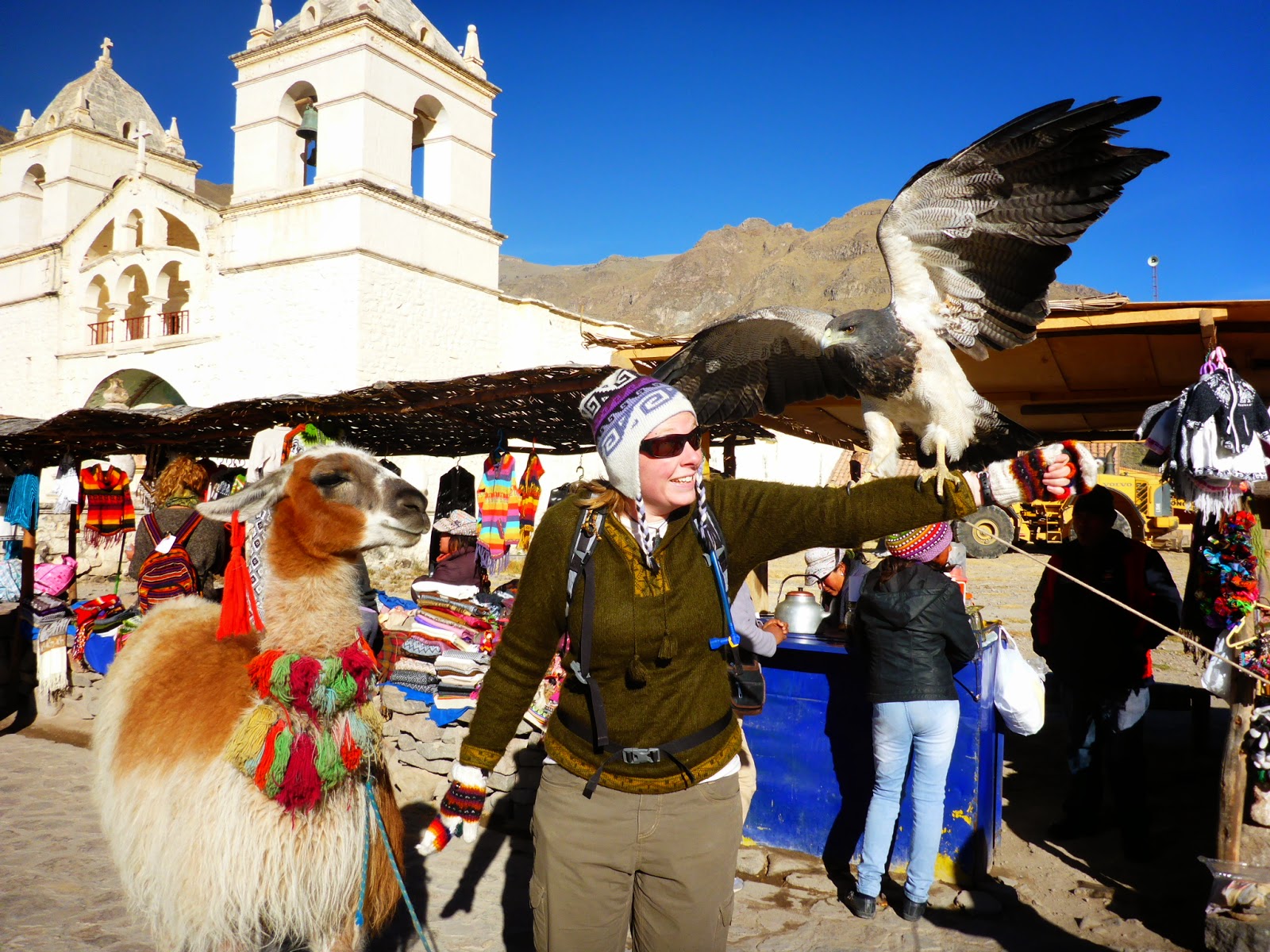
There are two main reasons we stopped in Arequipa: Colca Canyon and Juanita the Ice Maiden. Also, we took some respite here. It is really a beautiful city, clean, relatively easy to get around. And the altitude here is lower than Cusco, which is good, but it also has the climate of a desert, so it is very dry.
We arrived in the early evening, and we knew the next morning was going to be an early one. After a little dinner, we chilled at the hostel, played a little ping pong, and went to sleep early.
At about 3:30AM the next morning, a buys picked us up. By bus I mean large van with small seats, all of which were filled. It was a sardine packed ride. Most people slept until we got to Chavay, which is where we had breakfast. The altitude was noticeable. We had gone up about 3,000 feet. We were in Colca Canyon. Or next stop was one we had all been waiting for: the flight of the condor. They are huge! And beautiful and awesome. We stopped at some other viewing points along the way, as well. This is one of the deepest canyons in the world, but we never made it to the deepest part.
After lunch back in Chavay, we headed back to Arequipa, arriving around 5, exhausted. Another evening of ping pong and rest.
The following two days were mostly down time. We are kind of hitting a wall and looking forward to being back home. But we did go see the most well preserved human the world: Juanita. She was a sacrifice made by the Incas about 550 years ago. She had been buried at the summit of a volcano, and the temperature kept her completely in tact. She still had her hair, her internal organs, even much of her skin. Researchers have been able to learn so much from her. It was not intentional, her mummification. Several other children sacrifices were doing on the same mountain and on others. And she was found totally by chance. The volcano had a small eruption, and the ash melted some of the snow, exposing her. Vulcanists were climbing up to study the activity, and basically stumbled across her. She had rolled down about 100 meters from her original burial site, but fortunately remained as perfect as she has been. Basically, she was an ice ball. Anyway, she now rests in a freezer in a museum where everyone can observe her. It's kind of awesome. I had to get a picture off the internet because we weren't allowed to take photos in the museum.
We visited our last market in Peru. It's much cheaper here than in Chile, where everything is significantly more pricey. Still manageable, not like Paris or London expensive, but Peru is so cheap, and we got used to it.
On Thursday morning we caught a bus from Arequipa to Tacna. There, we got a collectivo to Arica, a town just over the border from Peru to Chile. We drove through the desert, for a stamp for exiting Peru, drove a little more, then got a stamp for entering Chile. We landed at a bus terminal that, as it turned out, is right down the road from our hostel. More about Arica in the next post!
Friday, July 11, 2014
Saturday, July 5, 2014
Lake Titicaca
We have just returned from a 2-day tour on Lake Titicaca. It was a little touristy, but that is to be expected. We were on a tour. Tourism, though, has actually had a positive impact on the communities there. Because of it, people are able to stay at home to work instead of having to go to Puno, get a job, and send money home. It has helped them with some autonomy in a world that is westernizing.
We boarded our boat with only day packs. Or big bags we stored in our hostel. For a single night, we didn't want to lug around our huge bags. No need. Our first stop was a floating island among a group of these called Uros. There are about 44 of these human-constructed islands in the area. They are made from the reeds that grow in abundance in the shallower waters of the lake. It feels a bit like walking on a sponge. It was really interesting, though, to see a bit how these people live entirely on subsistence. We got to take a ride on one of their reed boats. Since the introduction of plastic waste, the people have taken advantage of the floating coke bottles and began constructing their boats using the 2-liter bottles as a base. This allows the boat to last three times as long than if it were just made of reeds. Great repurposing. Also, the first language of these people is Quechua, so all of them are bilingual in Quechua and Spanish, some of them (like our guide) are trilingual. Amazing!
We moved on then to AmantanĂ Island, where we met our host family. Seriously, they freed us the best food we've had in Peru. Fortunately, our third housemate was a girl from Spain who speaks fluent Spanish and English, so with her and Tanya, communication was pretty good. There was a hike to the highest point on the island, and there is a temple there. The altitude of the lake is 12,507 feet. Add another couple hundred feet or so, and that was our climb. There are actually two peaks, Pachatata and Pachamama (Father Earth and Mother Earth). I forget which we did. Anyway, it felt like it was straight up. Tanya had been trying to recover from altitude sickness, but we keep climbing higher, so it's been rough on her. She skipped out on the climb. It's okay, because it was tough. I'm sure the locals carrying stuff on their backs up the hill thought we were all pansies, huffing and puffing our way up. At the top we took three coca leaves, walked around the temple three times, and made three wishes while putting our leaves in the door of the temple. And then we watched the sunset. It was incredible.
After dinner - super delicious - we went to a party where the locals like us to dress up in traditional clothes and we dance around with them to traditional music. It was really fun! But we were ready to sleep. The altitude definitely wears you out.
In the morning, we said adios to our wonderful host family. We then made our way to Tequile Island. More hills to climb. But with plenty of water, we did okay. After touring around a bit, we had lunch. Again, terrific. Fresh trout and more of the most delicious quinoa soup. They also showed us some of their local tricks and tools. By far the coolest was a plant that they use for soap. It smells just like shampoo, and when smashed up and put in water it lathers. And cleans. No chemicals or additives of any kind, and clean wool. We need this plant!
From here we went to Puno, where we will rest until our early morning bus. Lake Titicaca is definitely worth visiting.
We boarded our boat with only day packs. Or big bags we stored in our hostel. For a single night, we didn't want to lug around our huge bags. No need. Our first stop was a floating island among a group of these called Uros. There are about 44 of these human-constructed islands in the area. They are made from the reeds that grow in abundance in the shallower waters of the lake. It feels a bit like walking on a sponge. It was really interesting, though, to see a bit how these people live entirely on subsistence. We got to take a ride on one of their reed boats. Since the introduction of plastic waste, the people have taken advantage of the floating coke bottles and began constructing their boats using the 2-liter bottles as a base. This allows the boat to last three times as long than if it were just made of reeds. Great repurposing. Also, the first language of these people is Quechua, so all of them are bilingual in Quechua and Spanish, some of them (like our guide) are trilingual. Amazing!
We moved on then to AmantanĂ Island, where we met our host family. Seriously, they freed us the best food we've had in Peru. Fortunately, our third housemate was a girl from Spain who speaks fluent Spanish and English, so with her and Tanya, communication was pretty good. There was a hike to the highest point on the island, and there is a temple there. The altitude of the lake is 12,507 feet. Add another couple hundred feet or so, and that was our climb. There are actually two peaks, Pachatata and Pachamama (Father Earth and Mother Earth). I forget which we did. Anyway, it felt like it was straight up. Tanya had been trying to recover from altitude sickness, but we keep climbing higher, so it's been rough on her. She skipped out on the climb. It's okay, because it was tough. I'm sure the locals carrying stuff on their backs up the hill thought we were all pansies, huffing and puffing our way up. At the top we took three coca leaves, walked around the temple three times, and made three wishes while putting our leaves in the door of the temple. And then we watched the sunset. It was incredible.
After dinner - super delicious - we went to a party where the locals like us to dress up in traditional clothes and we dance around with them to traditional music. It was really fun! But we were ready to sleep. The altitude definitely wears you out.
In the morning, we said adios to our wonderful host family. We then made our way to Tequile Island. More hills to climb. But with plenty of water, we did okay. After touring around a bit, we had lunch. Again, terrific. Fresh trout and more of the most delicious quinoa soup. They also showed us some of their local tricks and tools. By far the coolest was a plant that they use for soap. It smells just like shampoo, and when smashed up and put in water it lathers. And cleans. No chemicals or additives of any kind, and clean wool. We need this plant!
From here we went to Puno, where we will rest until our early morning bus. Lake Titicaca is definitely worth visiting.
Subscribe to:
Posts (Atom)